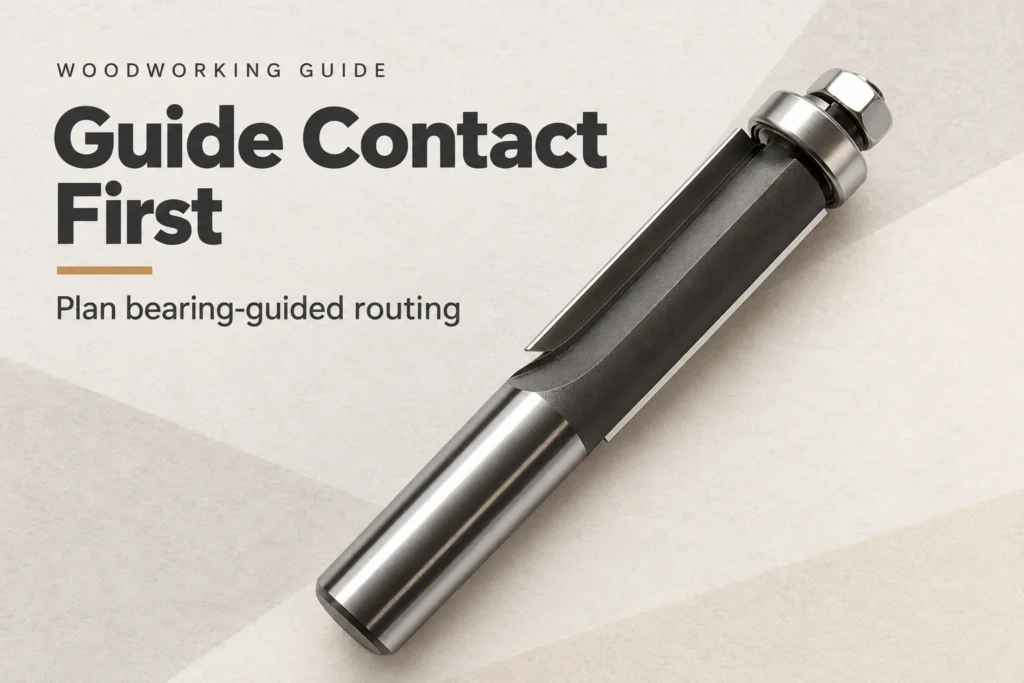
Bearing-guided router bits use a bearing to follow a template or an existing reference edge while the cutter shapes the workpiece. Before cutting, complete five checks: trace the guide route, inspect the template, confirm bearing and cutter geometry, validate a sample, and record the approved setup. JEEFOO lists a WB straight cutter with a bearing among its woodworking tools. Confirm the current drawing, intended application and machine compatibility with the supplier before treating this configuration as suitable for your job.
Table of Contents
1. Trace the Guide Route for Bearing-Guided Router Bits
For bearing-guided router bits, begin by identifying the surface the bearing will follow throughout the cut. Mark the start, straight sections, curves and exit on the setup drawing. The guide must provide continuous support wherever contact is required. A gap, step or damaged section in that surface can become a location where the intended relationship between tool and workpiece is lost.
2. Qualify the Physical Template
The template for bearing-guided router bits needs a smooth, continuous reference edge. Review its edges under suitable lighting and check the critical curves against the approved pattern. The bearing follows the physical guide surface, so defects there can affect the routed contour. Secure the template and workpiece using a method appropriate to the machine and operation, with fixtures positioned clear of the complete tool assembly.
3. Confirm the Bearing-to-Cutter Relationship
A bearing-equipped cutter does not establish the finished contour by its name alone. Obtain the bearing outside diameter, cutting diameter and location of the bearing along the tool. If a flush result is required, have the supplier confirm the corresponding geometry. A different diameter relationship can create an offset that must be included in the setup.
Check the guide-contact height against the workpiece and template thicknesses. The bearing must meet the intended guide while the cutting edge reaches the approved cutting zone. Include shoulders, fasteners and the holder in the clearance review. Confirm machine compatibility rather than choosing a machine arrangement solely from the product photograph.
4. Validate the Full Route on a Sample
Use representative stock and the approved operating procedure to test the complete contour, including corners and entry and exit areas. Inspect the result against the template’s intended geometry after the machine has stopped. Check whether any deviation repeats at the same location; that can help direct attention to the guide, fastening or setup.
5. Record the Approved Setup
For bearing-guided router bits, record the tool reference, verified bearing arrangement, template revision and accepted workpiece sample. Replacing either the cutter or the template should trigger a check of that relationship before the job resumes. For the WB bearing version, request the current drawing and application limits as part of the approval.
Keep a setup sheet with the bearing outside diameter, cutting diameter, bearing position, shank size, cutting length, material and machine arrangement. Note which face of the template provides contact and how fixtures avoid the complete tool assembly. These details make the approved configuration traceable when another operator repeats the work.
Bearing-Guided Router Bits: Frequently Asked Questions
Does every bearing-equipped bit cut flush with the template?
No. The finished relationship depends on the bearing diameter, cutting diameter and their position. Confirm the drawing for the exact bit. A bearing-equipped product name alone does not establish a flush cut or a specific offset.
What should be checked if the same contour defect repeats?
Stop the machine before inspection. Compare the defect location with the template edge, fastening points and guide-contact path. Check whether the template moved or the bearing lost contact. Correct the cause and qualify another sample before continuing production.
Can one speed or feed rate be used for every setup?
No universal setting is established by this article. Use the limits specified for the exact tool, router and material. Stock thickness, cutter size and machine arrangement affect the setup. Verify the complete route on representative stock using the approved operating procedure.
For product information, review the JEEFOO woodworking tools range and request the current WB drawing. For general template-routing precautions, consult the Amana Tool router-bit safety guide; it does not certify the JEEFOO WB configuration.
Reliable work with bearing-guided router bits starts with a continuous guide route and a confirmed cutter arrangement. Treat the JEEFOO WB bearing-equipped listing as a product to verify against those requirements, then qualify the complete setup on a representative part.