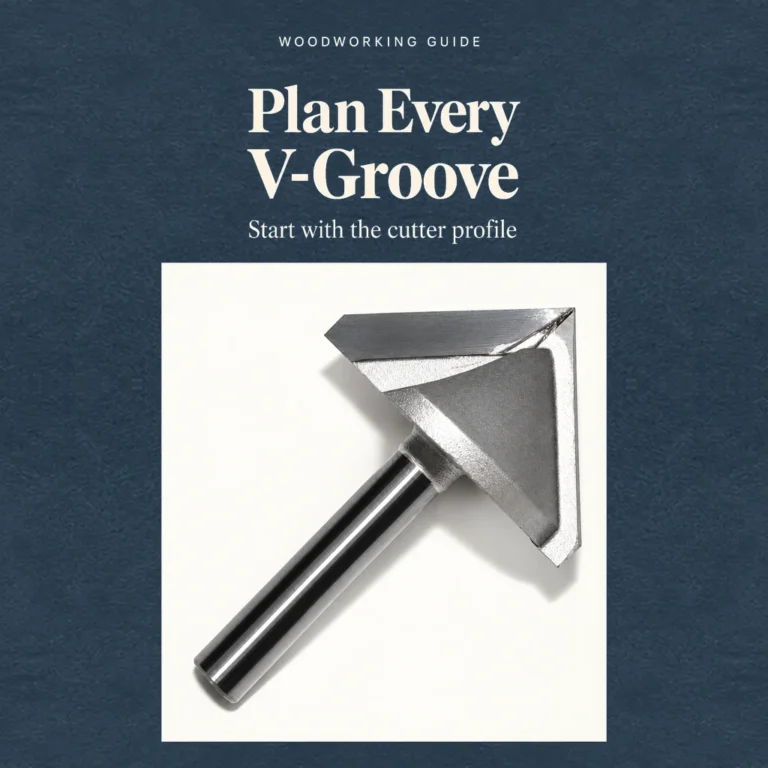
Spur straight cutters bring attention to two different parts of a groove: the boundary that remains and the material removed from inside it. A groove is not simply an empty volume. Its upper edges, side walls and floor become working surfaces, and they need not be formed by the same part of a cutting edge.
This distinction is useful when discussing wood grooves for furniture components, locating features or decorative details. Removing the required volume and preserving the adjacent surface are related tasks, but one does not automatically demonstrate the other. The explanation below separates those tasks without assuming a particular feed rate or a guaranteed finish.
How spur straight cutters relate to boundary formation
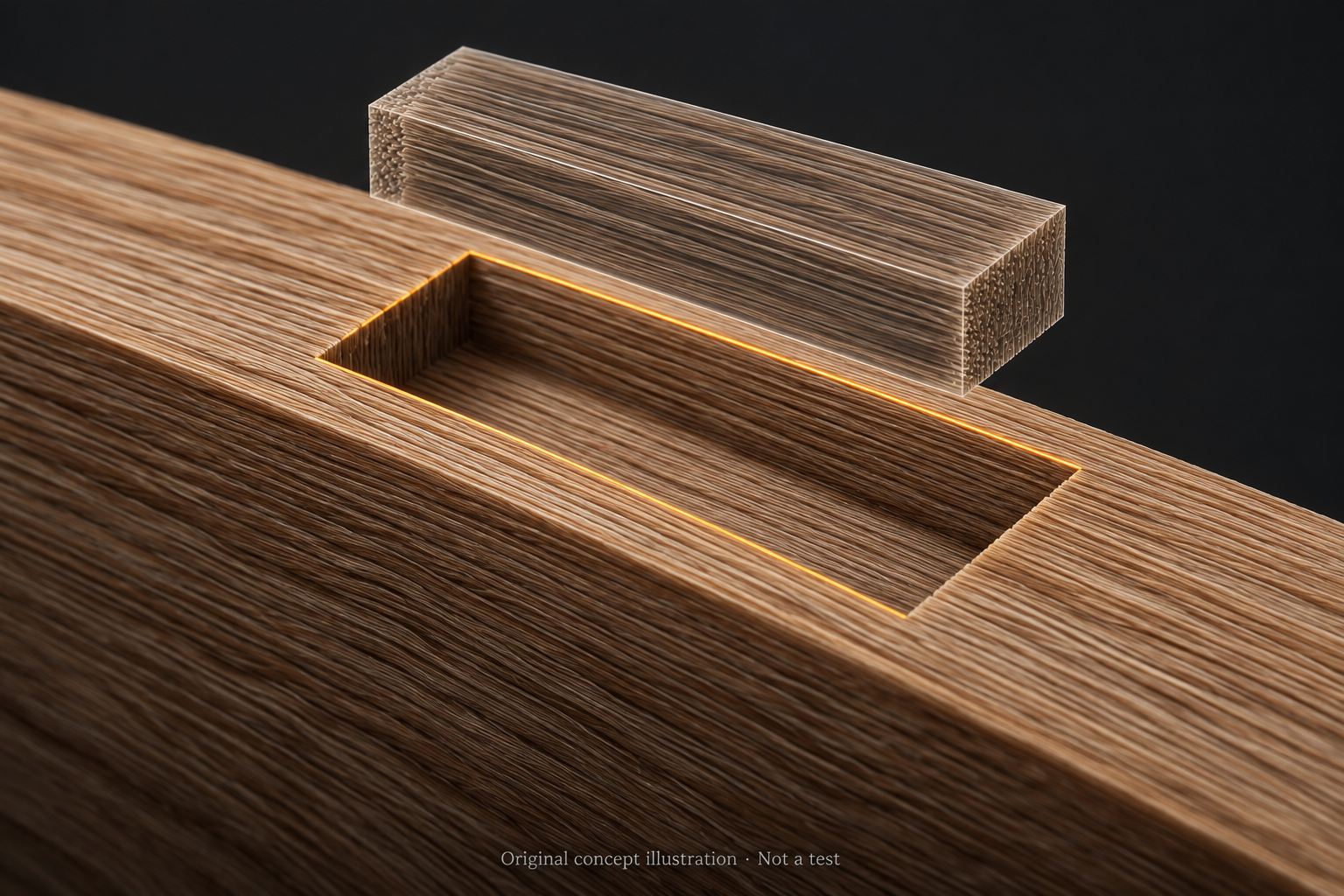
Imagine drawing the outline of a groove on a board. The wood inside the outline is the removal zone; the wood outside belongs to the finished part. At their meeting line, the operation must separate material without damaging the surface intended to remain. That line deserves attention even when the interior will be hidden by another component.
The Leitz User Encyclopedia distinguishes peripheral cutting edges from lateral cutting elements, including spurs, in grooving and rebating tools. Its discussion of certain boring tools provides a separate example: boundary fibres are severed before the hole interior is cleared. These examples explain different cutting roles, not identical geometry across every tool family.
For a router cutter, the practical question is therefore which part of the documented cutting geometry forms each required surface. A family name is useful for finding the tool, while its drawing establishes the actual cutting arrangement.
The boundary and the floor answer different questions
Consider a straight recess intended to receive another component. The opening determines where the recess meets the surrounding face; the side walls define its lateral enclosure; the floor sets the lower surface. Describing all three merely as “the groove finish” hides their different functions.
A damaged upper edge and a marked floor are consequently different observations. An acceptable floor does not establish that the adjacent face is intact, just as an attractive opening does not establish the floor’s depth. This is a way to define the machining problem, rather than a diagnosis that assigns every defect to one cutting feature.
The same reasoning helps designers and machining teams communicate. If the upper edge remains visible after assembly, identify that retained edge explicitly. If the recess locates another part, distinguish its contact surfaces from an area that provides clearance. Those descriptions connect the intended function to the relevant cutting surface without adding arbitrary universal tolerances.
Where the JEEFOO WB family fits
The JEEFOO WB Spur Straight Cutter, 6.35 × 12.7, is listed for grooving, slotting and related woodworking operations. Its stated material applications include solid wood, hardwood, plywood and MDF, subject to suitability for the selected operation. It is an appropriate product-family reference for a discussion of spur straight cutters.
The listing also asks users to confirm the product drawing and machine compatibility. Keep cutting diameter, shank size and cutting length as separately identified dimensions; do not assign the numbers in a compact model name to these functions without the drawing. Entry capability and operating limits likewise belong to the exact tool-and-machine combination.
Why material structure still matters
Leitz describes wood as a direction-dependent, non-uniform material with fibres that behave differently along and across their length. Its materials sections also distinguish solid wood from manufactured wood-based boards. This makes the stock description part of the cutting explanation, not just a purchasing label.
In a technical discussion, “a groove in wood” can therefore be too broad. Identify whether the retained surface is solid timber, a plywood face or another board surface, and describe the orientation of the feature on the part. A broad application list for spur straight cutters does not mean that every listed material will present the same edge appearance.
An exit edge changes the support condition
A groove that continues through the end of a board reaches a boundary where there is no further workpiece beyond the exit. Festool’s official groove-routing application guide uses a wooden splinter guard at the end to limit splitting. Its example also specifies secure clamping and following the equipment’s operating instructions.
This illustrates a separate contribution from workpiece support. Supporting a vulnerable exit and selecting a suitable cutting geometry are not competing explanations; they concern different parts of the operation. Any support must be securely integrated into a setup compatible with the machine, rather than treated as a loose accessory near the cutter.
The useful distinction
Compare spur straight cutters by relating verified cutting geometry to the surfaces the job must create. Think separately about the retained boundary, the internal removal zone and the support at the exit. This gives a clearer account of grooving than judging only the quantity of material removed, while keeping tool selection grounded in the actual WB documentation.