A small opening between interlocking fingers is not meaningful until its location is identified. It may be clearance between a finger tip and the opposing root, or separation along a face intended for bonding. Those are different features. The JEEFOO UB finger-joint cutter series is listed for finger-joint joinery and mating work in furniture and panel construction, with profiles selected for the application.[1] Understanding that profile includes understanding which surfaces should meet.
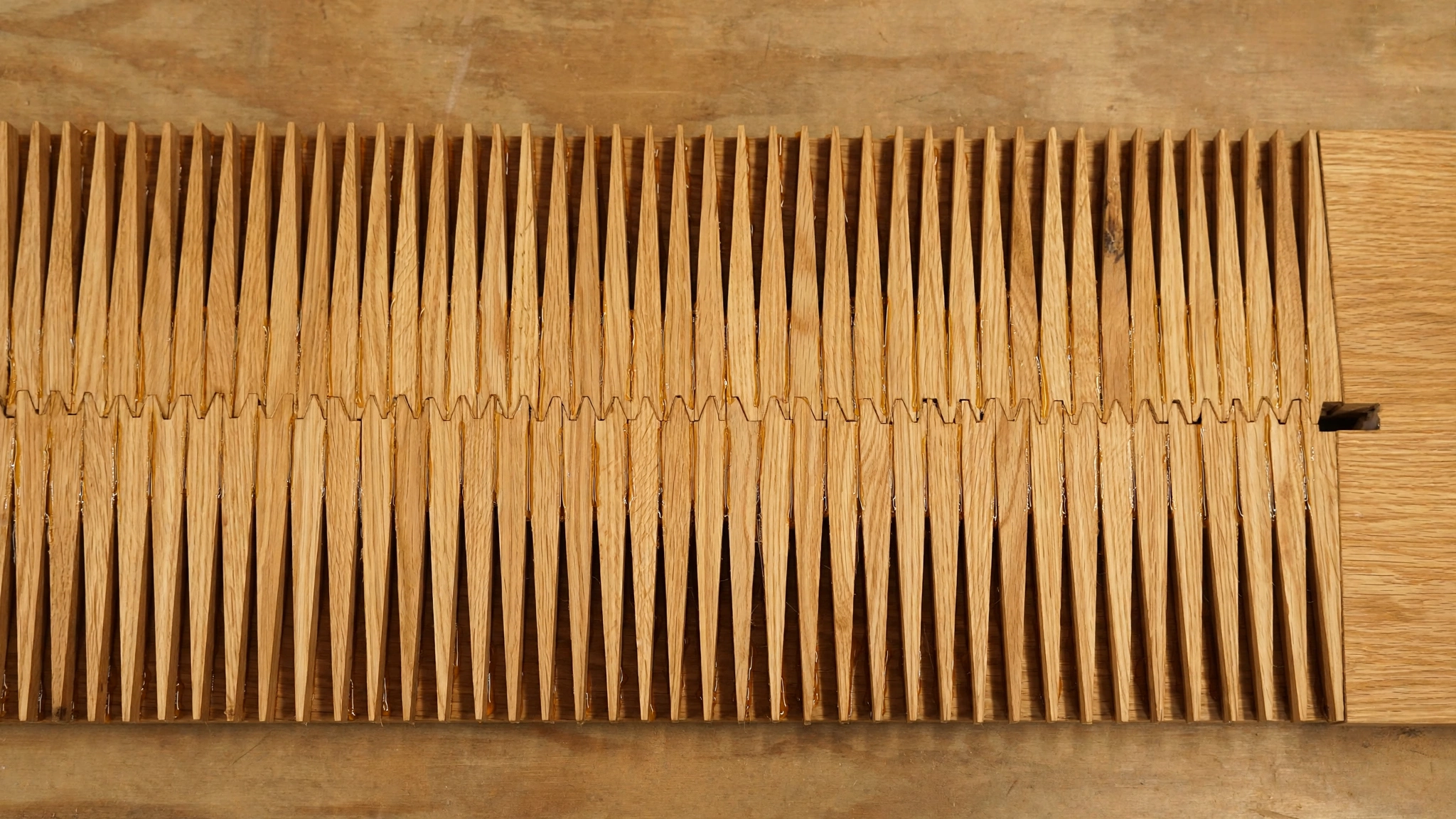
Follow the flanks, not only the ends
Natural Resources Canada describes finger-joined lumber as shorter pieces connected by intermeshing wooden wedges and adhesive. Machining the fingers provides side-grain surfaces that can be bonded, rather than relying on the plain end-grain faces of a butt joint.[2] The sloping sides, or flanks, therefore matter to the connection; the appearance of the finger ends alone does not describe the bonded interface.
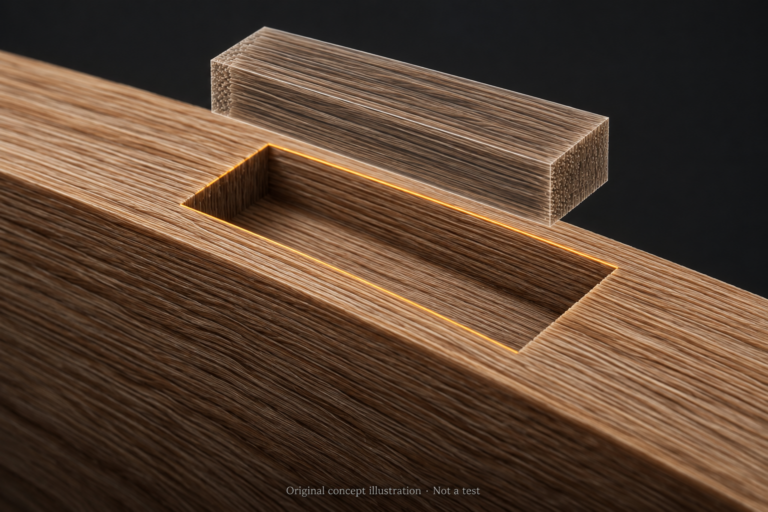
Picture a section through a joint whose design explicitly includes tip clearance. As the opposing fingers engage, the flanks can approach their intended bonding relationship while space remains beyond the tips. This is a conceptual reading of that geometry, not a report of a UB cutting trial. A void extending along a flank is a different observation from the specified end clearance, even if both look like a dark line in a photograph.
Some profiles retain a visible gap
Leitz’s finger-jointing documentation provides concrete examples of profiles that retain visible tip play after pressing. It also describes a shorter-finger option for which a closely sealed profile is possible through the choice of finger length.[3] Consequently, neither “every opening is wrong” nor “finger joints always need the same gap” follows from the term finger joint.
These are Leitz profile descriptions. Their dimensions, application classifications and machinery arrangements cannot be assigned to UB. Their value here is to demonstrate that closure at the tip is a design feature with alternatives, rather than a universal visual test for a successfully machined joint.
What the clearance can do
In their 2024 paper on birch and beech finger-jointed lamellas, Stolze and Militz explain the tip gap in the structural profiles they discuss as contributing to a thin bondline and self-locking engagement. They also identify the associated reduction of timber cross-section at the finger base.[4] Clearance therefore has both a functional purpose and a geometric cost; leaving a larger opening is not automatically beneficial.
The paper distinguishes several manufactured profiles and adhesive systems. Its experiments did not use a UB cutter, and its discussion does not establish a gap or pressing pressure for a furniture joint. The useful principle is narrower: the tip allowance belongs to a coordinated profile whose bonded faces and remaining wood section must work together.
Read the intended UB finger-joint cutter profile as a whole
The UB listing does not publish a finger-profile drawing or a required tip clearance.[1] It therefore cannot establish whether a particular visible gap is intentional. That decision needs the actual mating profile for the supplied configuration, including which region is an allowance and which region forms the bonded interface.
If that design specifies end clearance, trying to erase it merely because it remains visible changes the objective from producing the specified joint to chasing a different appearance. Conversely, a documented tip allowance offers no justification for an opening elsewhere along the bonding faces. This distinction helps interpret the machined shape without treating a photograph, insertion feel or a catalogue name as proof of joint strength. No universal gap, glue quantity or pressure adjustment is proposed here.
Sources checked on 5 November 2026: [1] JEEFOO, UB Finger-Joint Cutter Series. [2] Natural Resources Canada, Finger-joined lumber. [3] Leitz Lexicon, Planing and profiling, finger-jointing profile descriptions, section 3.4. [4] Stolze and Militz, Materials 17 (2024), 5063, introduction and described study scope.
Related reading: UB Finger-Joint Cutters: Preserving Sound Wood Beneath the Glue Line