For a bonded solid-wood finger joint, a UB finger-joint cutter prepares surfaces that must transfer load through the adhesive and into the wood. The JEEFOO UB series is listed for finger-joint joinery and mating work in furniture and panel construction.[1] In that application, preserving sound wood at the cut surface matters alongside producing the intended mating profile.
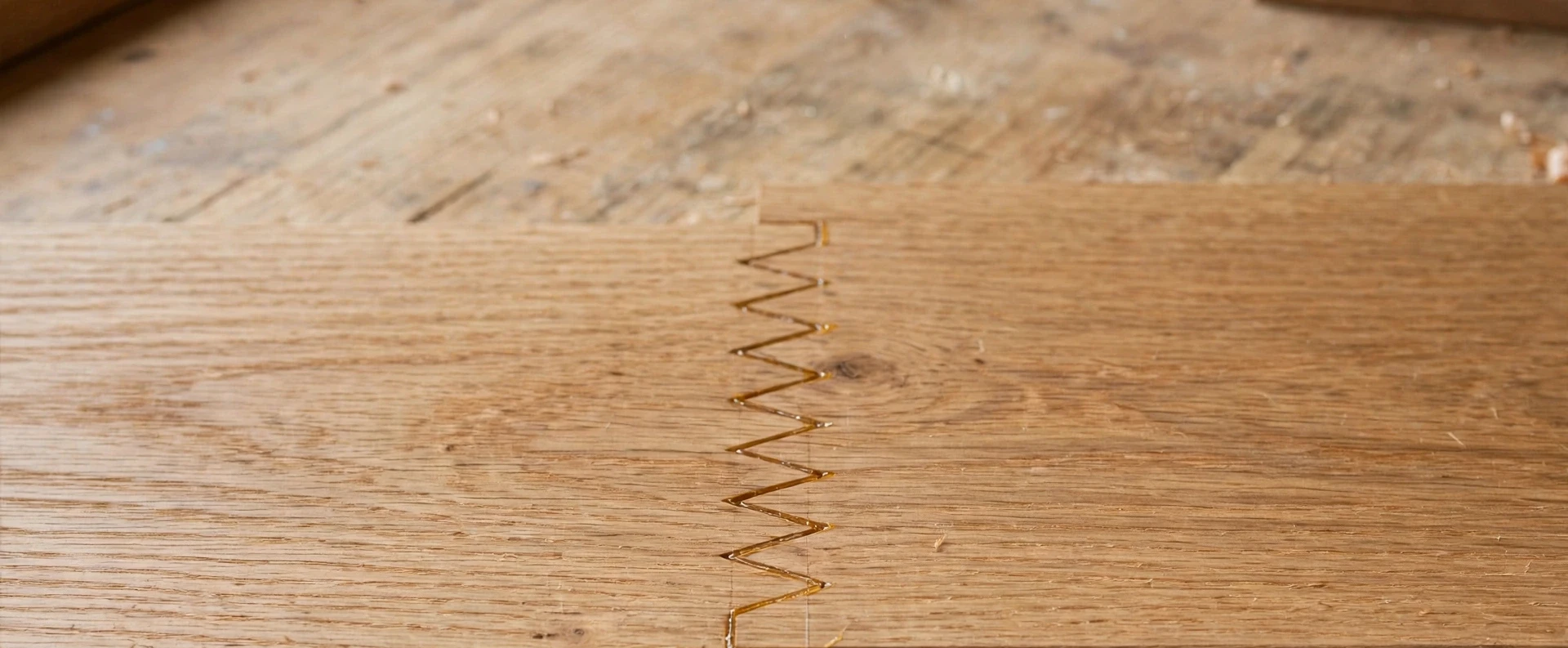
Follow the connection below the adhesive
Consider a small wood fragment that remains loosely attached after machining. Adhesive may stick to that fragment, yet the connection still depends on how firmly the fragment is attached to the wood beneath it. Strong attachment at the adhesive surface alone cannot describe the entire load path.
The USDA Wood Handbook explains bond performance through the adhesive, the wood and their intervening regions. It identifies fractured or crushed surface wood as a possible weak link below the adhesive.[2] This supplies a useful way to think about the UB application: the surface created by cutting becomes part of the bonded connection, rather than disappearing from consideration when glue is applied.
What damaged cells change
Wood is a cellular material. When machining crushes cells or leaves poorly attached fragments, the resulting surface differs from one with cleanly cut, well-supported cells. The handbook connects this damage with both reduced support and interference with adhesive wetting and penetration.[2] These are related effects: the adhesive needs contact with the wood, and the contacted wood must carry the transferred load.
Its example of glazing concerns a jointer operated at excessive feed. That example illustrates how a shiny surface can contain compressed cells; it does not establish a UB feed limit or diagnose any particular routed finger joint. The source also recognizes that some adhesive systems can penetrate and reinforce damaged cells. Damage therefore cannot be reduced to an automatic pass-or-fail rule based on appearance.
Loose dust and weakly attached wood require different attention
Frihart’s research paper, Many Roles of Wood Adhesives, distinguishes accumulated dust from other mechanically weak surface conditions, including crushing and fragments produced during planing. Identifying a weak layer can require microscopy.[3] The published observations concern those preparation methods, not a tested UB cutter.
For the workshop, an important implication follows: removing loose dust addresses what lies on the surface, but does not establish that wood just beneath it is sound. Likewise, seeing fragments on a joint face does not reveal their attachment strength or explain every bonding failure. Surface preparation, the selected adhesive and the complete bonded assembly remain connected questions.
A UB finger-joint cutter: preserve the profile while investigating the surface
The UB finger-joint cutter listing calls for selecting the actual profile for the material and operation.[1] That profile must remain consistent with the joint design. Sanding finger faces by eye to make them look cleaner can change the mating geometry; it is not a surface-repair method proposed here.
If a bonding investigation is needed, retain an unbonded machined sample so that the cut surface can be examined separately from adhesive application. Any comparison of preparation methods should use the intended wood and bonding process, with evaluation appropriate to the finished product. This is an editorial investigation approach, not a UB test result or a substitute for qualified joint assessment.
The practical objective is to produce the required fingers while preserving a surface capable of participating in the bonded load path. Neither a generic instruction to add glue nor a visually neat profile establishes that outcome. No finger dimensions, glue quantity, clamping pressure or joint-strength rating is inferred from the UB catalogue.
Sources checked on 5 November 2026: [1] jeefoowoodbits.com, UB Finger-Joint Cutter Series; [2] USDA Forest Products Laboratory, Wood Handbook, 2021, chapter 10, pages 10-1–10-3; [3] Charles R. Frihart, Many Roles of Wood Adhesives, 2014, pages 1–2. The research paper’s later proposed adhesive-repair mechanisms are not used as established product claims.
Related reading: GY or GW Router Bit? Choose the Groove Floor Before the Tool Size and GW Pocket Cleanup: How Rotating Mass Can Load the Spindle.