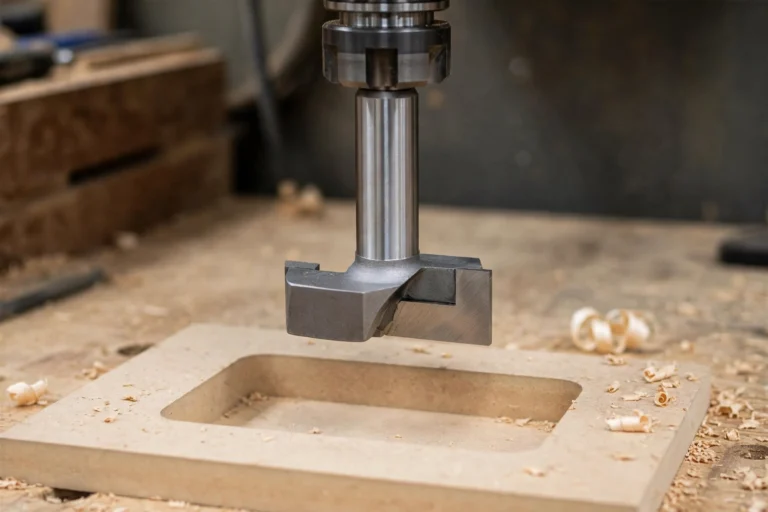
Surfacing an MDF spoilboard for a flow-through vacuum table has two purposes: establishing the supporting plane and preparing an air path through the board. A clean, flat upper face addresses the first purpose without necessarily completing the second.
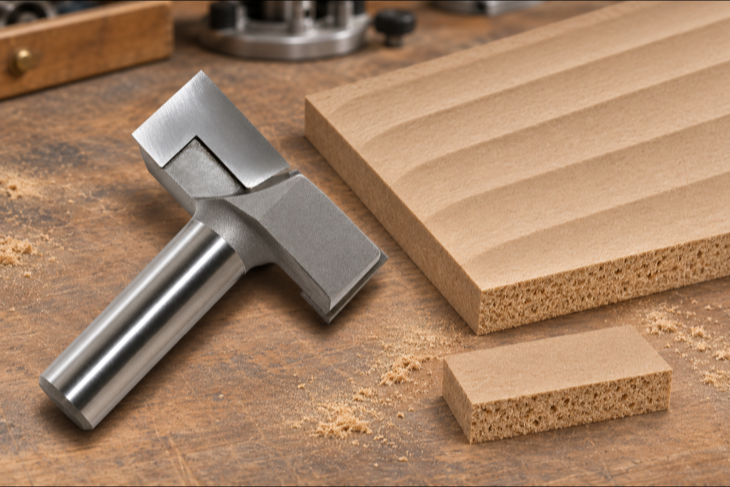
The JEEFOO GW 12.7 x 45 listing includes MDF surface cleanup among its applications.[1] That connects this question to a real cutting operation. It does not establish that this model is approved for a particular vacuum table. The explanation below concerns the board being prepared, rather than a tested GW holding result.
Follow the air through both faces
A flow-through spoilboard sits between the workpiece and the vacuum distribution beneath it. Black Box Vacuum describes a route through surfaced MDF or LDF to the table grid, plumbing and pump. Its FAQ identifies the resinous layers on the board’s upper and lower faces as layers to remove when preparing that route.[2]
The core and the faces therefore have different roles in the explanation. ShopSabre describes MDF’s smooth, heat-sealed surfaces as less porous than its interior.[3] Calling the entire sheet “porous MDF” does not describe every part of the path equally well. Air travelling through the thickness encounters both faces as well as the core.
Consider a new board with only its visible upper face surfaced. This is a conceptual example, not a workshop trial. Even if that operation produces the required plane, it says nothing about the condition of the untouched lower face. Further polishing or recutting the top cannot be treated as evidence that the lower restriction has been addressed.
Why two-face preparation is different from flatness
LMT Onsrud’s guidance for universal flow-through spoilboards describes initial surfacing on both sides to improve porosity and establish flat, parallel surfaces.[4] The two outcomes appear together because one preparation operation can serve both functions. They remain different properties: flatness describes geometry, while air passage depends on the material along the route.
This distinction helps define the purpose of a surfacing pass. When preparing a new board, the question includes whether the relevant face layers have been removed under the equipment’s procedure. When maintaining a used board, the condition of the supporting surface and accumulated cutter grooves also matter. Neither situation is resolved by judging the attractiveness of the machining marks alone.
Open faces and controlled edges
Improving passage through the faces does not mean allowing unrestricted entry everywhere. An exposed edge can provide a bypass into the porous core instead of directing the available airflow through the intended working area. Onsrud separately discusses covering unused areas and limiting leakage at the board edges.[4]
ShopSabre likewise distinguishes face preparation from edge sealing, while noting that certain HiFlow arrangements may not require the same edge treatment.[3] Consequently, opening the faces and controlling leakage are compatible objectives, but the actual treatment belongs to the installed vacuum system. Advice for this through-board arrangement should not be transferred automatically to a dedicated gasketed fixture.
Keep the cutter within the process
A GW catalogue description of MDF surfacing establishes an application family, not a preparation depth, an acceptable remaining board thickness or a hold-down rating. Onsrud’s recommendation of a large-diameter spoilboard cutter is also not an identification of the GW model.[1][4]
Select and operate the actual cutter within the machine and tool instructions, with the board secured by the approved preparation method. After preparation, the complete vacuum arrangement still has to support the intended work. The useful result of this distinction is a clearer process question: has the operation prepared both the support geometry and the intended through-board air path?
Sources
Sources checked on 5 November 2026:
- JEEFOO, GW 12.7 x 45 product listing — https://www.jeefoowoodbits.com/gw-cleaning-bottom-router-bit-12-7-45/
- Black Box Vacuum, FAQ — https://blackboxvac.com/faq/
- ShopSabre, MDF vs. LDF — https://www.shopsabre.com/mdf-vs-ldf-which-spoilboard-is-better-for-cnc/
- LMT Onsrud, The Importance of Spoilboards in the Machining Process — https://onsrud.com/articles/The-Importance-of-Spoilboards-in-the-Machining-Process.asp
Related reading: GW Pocket Cleanup: How Rotating Mass Can Load the Spindle · GY or GW Router Bit? Choose the Groove Floor Before the Tool Size