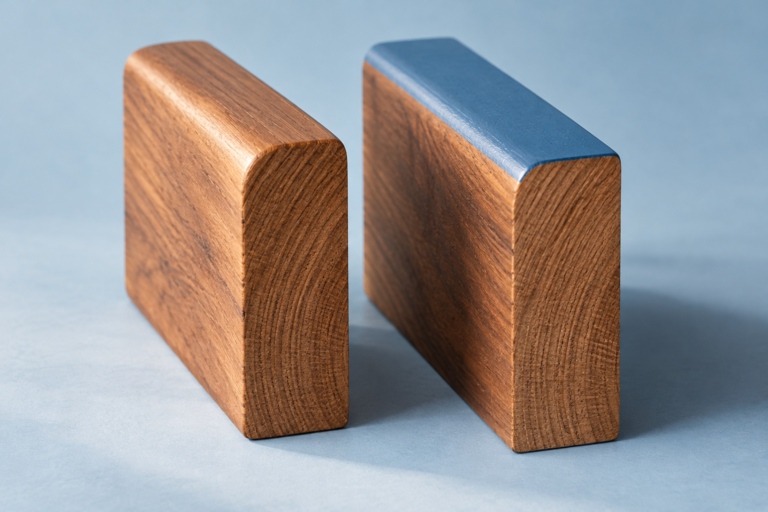
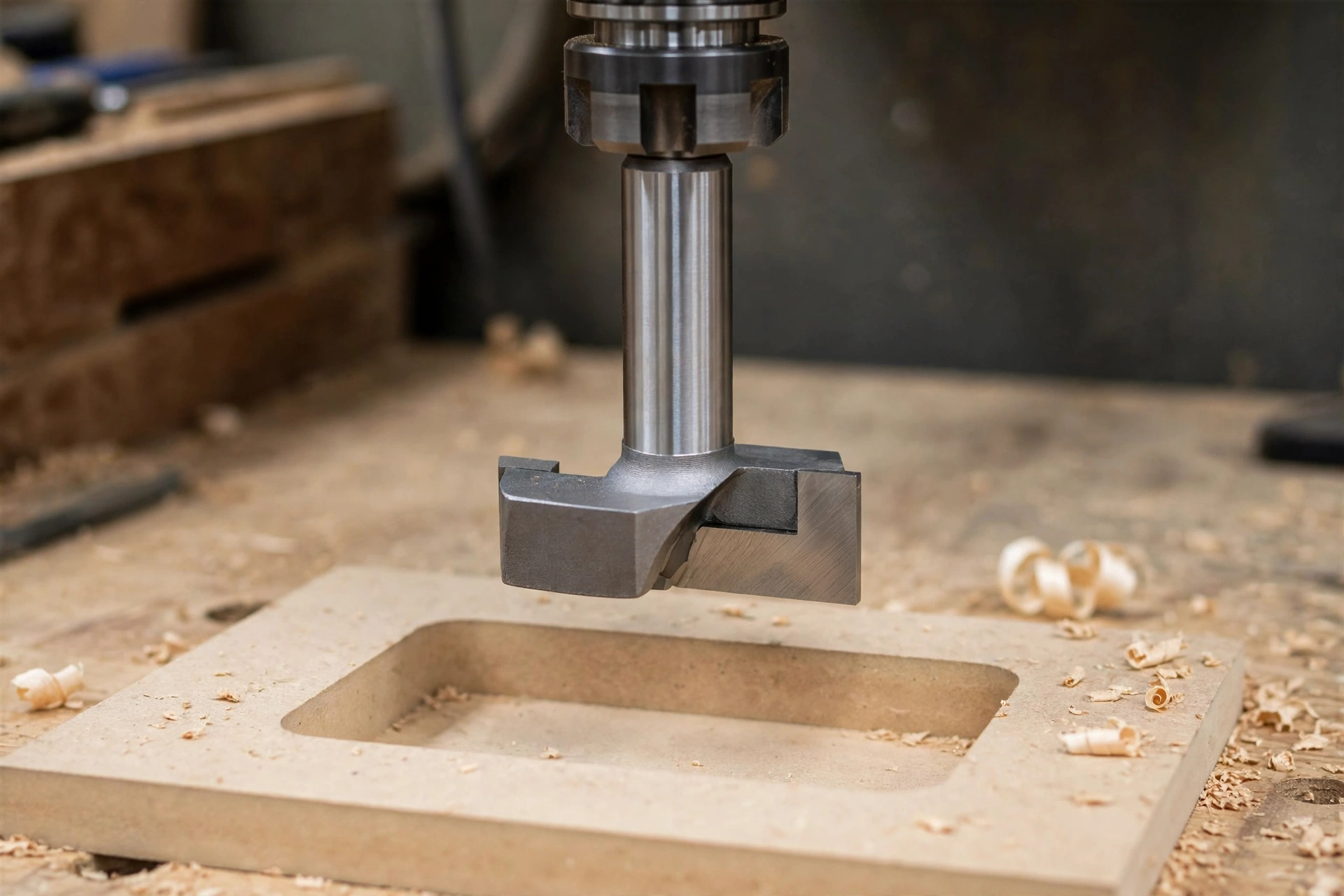
The GW cleaning-bottom router bit is listed for leveling recess floors and cleaning woodworking pockets, including compatible MDF, plywood and solid wood applications.[1] Its flat-bottom cutting profile describes the surface it is intended to produce. During operation, however, the cutter also belongs to a rotating assembly. The way mass is distributed within that assembly can generate loads before chip formation is considered.
This matters when discussing vibration during pocket cleanup. A rough floor is an observation, not a measurement of unbalance. Understanding the rotating load helps identify a physical question worth investigating without declaring a particular GW cutter defective.
A force that travels around the axis
In its balancing fundamentals, Schenck describes static unbalance using a rotor with additional mass in the plane of its centre of gravity. Once the rotor turns, that unbalance produces a centrifugal force perpendicular to the rotation axis.[2] The word static identifies the form of unbalance; the rotating force is an operating consequence.
Follow the direction of that force through one revolution. It turns with the rotor, so the bearing system experiences a changing direction of load. HAIMER’s tool-balancing explanation connects this rotating force with vibration.[3] The mass does not need to touch the wood to create the unbalance load: its rotation is the process under discussion.
Speed changes the force even when the mass stays put
HAIMER states that the centrifugal force associated with a given unbalance increases with the square of spindle speed.[3] A simple mathematical illustration is that doubling the speed makes that force four times as large, provided the unbalance remains the same. This is a proportional relationship, not a proposed pair of operating speeds for the GW.
It also does not mean that every measured vibration will become four times larger. The relationship describes the exciting force. Predicting the movement of a complete machine requires its dynamic response as well. A catalogue description of a flat cutting profile supplies neither that response nor a measured unbalance value.
Opposing masses can leave a turning effect
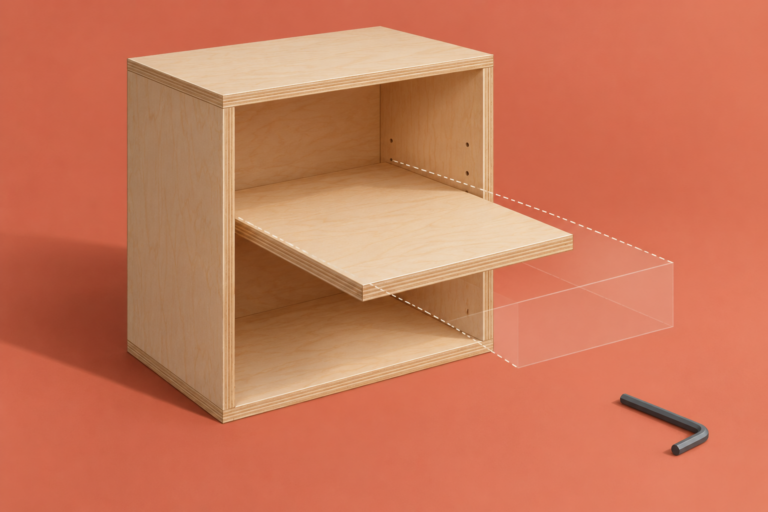
There is another useful case in Schenck’s explanation. Imagine equal, opposite unbalances located in two different planes along a rotor. The centre of gravity can remain on the rotation axis. Nevertheless, during rotation their forces form a couple, producing a moment and opposing forces at the bearings.[2]
The separation along the axis is essential. Two equal forces pointing in opposite directions do not remove the turning effect when their lines of action are separated. This conceptual rotor explains why mass distribution along the assembly matters, as well as its distribution around the axis. It is not a description of two weights found inside a GW cutter.
What this changes in a GW cleaning-bottom router bit assessment
Schenck identifies limiting bearing forces and shaft deformation as objectives of balancing.[2] For a woodworking tool assembly, that places the assessment at the level of the rotating system. It is a different physical inquiry from deciding whether an individual edge engaged more material or whether the programmed pocket overlap left a ridge.
The GW product page provides no balance grade, residual-unbalance measurement or operating-speed approval that can be derived from the sources used here. Those requirements must come from the applicable cutter, holding system and machine documentation. The explanation is not a procedure for grinding material away, adding weights or running a speed sweep to diagnose the assembly.
If vibration or unusual noise appears, the supplier’s GW guidance calls for stopping and reviewing the condition.[1] Unbalance is one possible mechanism to assess through an appropriate process; the appearance of the floor alone cannot establish it. The useful distinction is between the geometry that forms the pocket and the rotating mass that can load the spindle while a GW cleaning-bottom router bit carries that geometry around.
Sources checked 5 November 2026: [1] jeefoowoodbits.com, GW product page. [2] Schenck SmartBalancer4 technical documentation, sections 6.2.2–6.2.3, page 49. [3] HAIMER Tool Dynamic brochure, published explanation of centrifugal force and spindle speed. No GW balance test or machining trial was performed.